 Shanghai Lisheng Automation Technology

Intelligent leadership in industrial upgrading
Siemens S7-1500 PLC vs S7-1200 PLC: Which One Should You Choose for Industrial Automation?
Introduction
Siemens PLC systems are among the most widely used industrial automation controllers in the world. In modern factory automation projects, the Siemens S7-1200 and S7-1500 PLC series are two of the most common choices for machine control, process automation, and intelligent manufacturing systems.
Although both PLC families belong to the Siemens SIMATIC automation platform, they are designed for different industrial applications. Choosing the correct PLC controller can improve system stability, reduce project cost, and increase future expansion capability.
This guide explains the main differences between Siemens S7-1500 and S7-1200 PLC systems and helps engineers, OEM machine builders, and factory automation integrators select the right automation solution.
What Is Siemens S7-1200 PLC?
The Siemens S7-1200 PLC is a compact automation controller designed for small and medium industrial automation systems. It combines integrated I/O, communication capability, and flexible programming within a compact industrial controller.
S7-1200 PLCs are commonly used in:
- Small automation machines
- Packaging equipment
- Conveyor systems
- Pump control
- Water treatment systems
- Food processing equipment
- OEM machinery
The S7-1200 series is known for easy installation, cost efficiency, and simple engineering integration.
What Is Siemens S7-1500 PLC?
The Siemens S7-1500 PLC is a high-performance industrial automation controller designed for advanced machine control and large-scale factory automation systems.
Compared with S7-1200, the S7-1500 offers:
- Faster CPU processing
- Higher communication performance
- Advanced motion control
- Improved cybersecurity
- Better diagnostics
- Larger program capacity
- More expansion capability
S7-1500 PLC systems are widely used in:
- Smart manufacturing
- Industrial production lines
- CNC machinery
- Robotics systems
- Process control systems
- Factory digitalization projects
- Industrial Ethernet architectures
Main Differences Between S7-1200 and S7-1500
1. Performance
The Siemens S7-1500 PLC provides significantly higher processing speed than the S7-1200 series. It is suitable for complex automation systems requiring fast logic execution, large data handling, and multiple industrial communication tasks.
S7-1200 controllers are more suitable for standard automation projects with moderate process complexity.
For high-speed industrial applications, S7-1500 is the preferred choice.
2. Communication Capability
Both PLC systems support PROFINET communication, but the S7-1500 platform offers stronger industrial networking capability.
S7-1500 PLCs are better for:
- SCADA systems
- MES integration
- OPC UA communication
- Industrial cloud connectivity
- Multi-network architectures
S7-1200 is suitable for smaller machine-level communication systems.
3. Expansion and Flexibility
S7-1500 PLC systems support more I/O modules, communication processors, and technology modules than S7-1200.
This makes S7-1500 ideal for:
- Large production systems
- Distributed automation architectures
- Multi-machine control projects
- Future factory expansion
S7-1200 is more compact and suitable for space-limited control cabinets.
4. Motion Control
For advanced servo control and multi-axis synchronization, Siemens S7-1500 Technology CPUs provide better motion control functionality.
Applications include:
- CNC systems
- Robotic automation
- Cutting machinery
- Servo positioning systems
S7-1200 can handle basic motion tasks but is not intended for high-end synchronized motion control applications.
5. Safety Automation
Siemens S7-1500 Fail-safe CPUs support advanced industrial safety systems including:
- Emergency stop systems
- Safety doors
- Safety relays
- SIL safety applications
- Robotic safety systems
S7-1200 also supports safety functions but is typically used in smaller safety automation environments.
Industrial Applications
Siemens S7-1200 Applications
Suitable for:
- Small machine automation
- OEM equipment
- Water treatment
- Pump stations
- Conveyor systems
- Building automation
Siemens S7-1500 Applications
Suitable for:
- Intelligent manufacturing
- Smart factories
- Robotics systems
- Industrial process control
- Large automation production lines
- Factory digitalization systems
Which Siemens PLC Should You Choose?
Choose Siemens S7-1200 If:
- Your project is small or medium-sized
- You need cost-effective automation
- Limited I/O is required
- Motion control is simple
- Space is limited
Choose Siemens S7-1500 If:
- Your automation system is complex
- High-speed communication is required
- Multiple industrial networks are needed
- Future expansion is important
- Advanced motion or safety control is required
Advantages of Siemens PLC Systems
Both Siemens S7-1200 and S7-1500 PLC systems offer:
- Reliable industrial performance
- Strong global support
- Integration with Siemens HMI panels
- TIA Portal engineering compatibility
- Stable industrial communication
- Long-term automation reliability
These advantages make Siemens PLC controllers one of the most trusted industrial automation platforms worldwide.
Conclusion
The Siemens S7-1200 and S7-1500 PLC series are both powerful industrial automation solutions, but they are designed for different project requirements.
S7-1200 is ideal for compact and cost-effective automation systems, while S7-1500 is better suited for advanced industrial control, smart manufacturing, and large-scale automation projects.
Choosing the correct Siemens PLC controller depends on:
- System complexity
- Communication requirements
- Expansion needs
- Motion control requirements
- Safety functionality
- Industrial application environment
For modern industrial automation systems, both Siemens PLC platforms continue to provide reliable, scalable, and efficient automation solutions for factories around the world.
Related recommendations
-

-
-
-
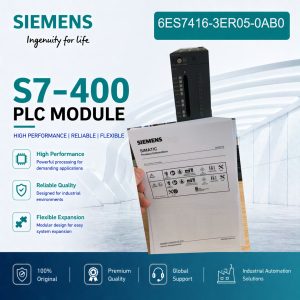
Siemens 6ES7416-3ER05-0AB0 CPU Module for Industrial Control Applications
0Siemens high-performance CPU module for industrial control and automation systems.
View details